

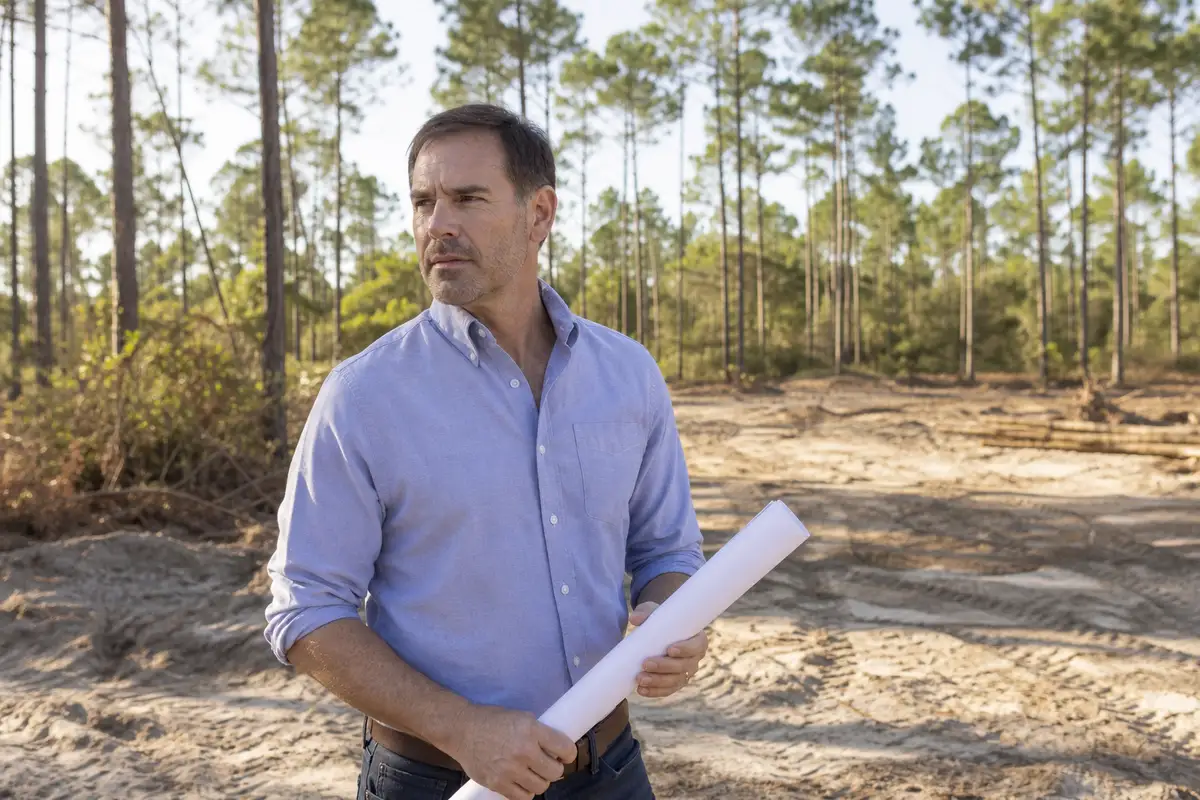
You Own the Land. Now What?
You found your piece of Bay County, Florida — maybe a few wooded acres outside Panama City, or a quiet parcel further inland where the county opens up into genuine rural land. You have been holding it, paying property taxes, and picturing a home on it for longer than you would like to admit.
The question that stops most landowners in their tracks is not whether they want to build. It is how to finance it without draining savings, taking on two separate loans, or navigating a process that feels designed for someone else entirely.
A USDA construction-to-permanent loan may be one of the most practical paths available to you — and it is one that far fewer people know about than the standard USDA purchase loan that has been getting attention lately as a no-down-payment option for rural homebuyers.
What a USDA Construction Loan Actually Does
The program works differently from a conventional construction loan. Instead of borrowing money to build, then refinancing into a permanent mortgage at a second closing, a USDA construction-to-permanent loan handles both phases in a single transaction.
That means one application, one appraisal, and one closing. Once construction wraps, the loan converts to your long-term mortgage without requiring you to restart the approval process.
For eligible borrowers, there is no down payment requirement. If you already own your land outright, that equity may count as your contribution — which could make the path to a finished home more accessible than you expected.
You can explore the full program details on our USDA construction loan program page.
Bay County’s Rural Character and USDA Eligibility
Bay County occupies a stretch of Florida’s Panhandle where the landscape shifts quickly from beach resort towns to pine flatwoods and rural communities. Panama City and its immediate surroundings carry a denser population, but the county extends into areas that USDA maps recognize as rural.
If your land sits outside the denser portions of the county — in communities or unincorporated areas beyond Panama City’s urban core — there is a reasonable chance your parcel could fall within a USDA-eligible zone. That eligibility is parcel-specific, which means the only reliable way to know is to run your address through the official USDA eligibility map or work with someone who can do it for you.
This matters because USDA construction financing is only available for properties in eligible areas. Getting that confirmed early saves you from investing time in a process that may not apply to your land.
Who This Program Is Designed For
USDA construction loans are designed for borrowers who plan to build a primary residence in a rural area. You do not need to be a first-time homebuyer, but the home you are building must be where you will live — not a vacation property or investment.
Income limits apply. USDA programs are structured to serve moderate-income households, so there is a ceiling on how much your household can earn and still qualify. Those limits are adjusted for household size and updated periodically, so they are worth verifying at the time you apply.
Credit requirements are more flexible than conventional financing in many cases, but lenders still review your full financial profile. If your credit history has some rough patches, it is worth having a conversation rather than assuming you would not qualify.
Jim Blackburn, NMLS #1072866, works with borrowers across a range of financial situations and can give you an honest read on where you stand before you commit significant time to the process.
How the Construction Phase Works
One of the more practical questions landowners ask is how draws work during construction. Under this program, funds are released to your builder in stages as work is completed and inspected — not as a lump sum upfront.
That structure protects you. It means your builder is motivated to complete each phase correctly before accessing the next portion of funds. It also means you are not carrying the full loan balance from day one.
You will need to work with an approved builder. Not every contractor has experience with USDA construction loans, and finding one who does — or who is willing to get oriented on the requirements — is an important early step. Our team can help you think through that process as part of your overall plan.
For a broader look at how the financing journey unfolds from pre-qualification through closing, our step-by-step process walks through what to expect at each stage.
What to Gather Before You Start
Moving through any construction loan efficiently comes down to documentation. The more organized you are at the front end, the smoother the process tends to run.
You will generally need proof of income, two years of tax returns, documentation of your land ownership and any existing liens, a signed contract with your builder, and plans or specifications for the home you intend to build. If you have an existing mortgage on the land, that information will factor into how the loan is structured.
Running rough numbers with our mortgage calculators can help you think through the overall loan size before you sit down with a lender.
USDA loans have published loan limits that vary by area, and there have been recent adjustments at the federal level that may affect what is available to borrowers in Bay County. Jim Blackburn, NMLS #1072866, stays current on those changes so you are working with accurate information rather than outdated figures.
Making the Move From Landowner to Homeowner
Holding land in Bay County is a meaningful asset. Turning it into a finished home — without a large down payment, without two separate closings, and with financing designed specifically for rural construction — is a goal worth taking seriously.
The process has moving parts, and every parcel, builder relationship, and borrower profile is different. That is why talking through your specific situation before making assumptions about what is or is not possible tends to serve people well.
You can review the loan programs available through Stairway Mortgage to see the full picture of what might fit your situation, or go straight to the program that brought you here.
When you are ready to find out whether your Bay County land and your plans line up with what this program offers, Talk to Our Team and let us take a look at the specifics together. You can also reach us directly at (954) 993-1625.