
Build New Without Breaking the Bank in Eligible Rural Areas
Constructing a custom home in a rural area presents unique financing challenges. Traditional construction loans often require substantial down payments and complex approval processes that exclude many qualified buyers. USDA construction loans offer an alternative path—combining the benefits of zero-down-payment financing with the flexibility to build from the ground up. This comprehensive guide reveals how eligible borrowers can leverage USDA financing to construct homes in designated rural and suburban areas, navigate the approval process, and avoid common pitfalls that derail construction projects.
Key details you'll discover:
- How USDA construction-to-permanent financing works as a single-close loan that eliminates the need for refinancing after construction (USDA Rural Development Single Family Housing Programs)
- Geographic eligibility requirements that qualify approximately 97% of U.S. land area for USDA financing (USDA Property Eligibility Map)
- Income qualification guidelines that restrict USDA construction loans to households earning below 115% of area median income (USDA Income Eligibility Standards)
- Builder and contractor approval processes that ensure construction quality and project completion (HUD Construction Requirements Overview)
- Property specifications that mandate primary residence use and prohibit income-producing features like commercial facilities (USDA Property Requirements)
- Construction timeline requirements that typically allow 12 months for project completion with possible extensions
- Budget considerations including land acquisition costs, construction draws, and permanent financing conversion
- Alternative construction financing options for borrowers who exceed income limits or prefer conventional approaches
Ready to explore your options? Schedule a call with a loan advisor.
What Is a USDA Construction Loan?
A USDA construction loan combines construction financing with permanent mortgage financing in a single-close transaction. Unlike traditional construction projects that require separate construction loans followed by permanent financing, USDA construction-to-permanent loans lock in your financing terms at the initial closing. This approach eliminates duplicate closing costs, repeated qualification processes, and financing-terms risk during the construction phase.
The USDA Rural Development program guarantees these loans through approved lenders, enabling qualified borrowers to finance both land purchase and construction costs without requiring any initial investment beyond closing costs. This financing structure serves families who want to build in eligible rural and suburban areas but lack substantial cash reserves for traditional construction financing.
How does USDA construction financing differ from conventional construction loans?
USDA construction loans provide several distinct advantages:
- Single closing process - Lock in permanent financing terms before construction begins, avoiding the uncertainty of refinancing after project completion
- Flexible funding structure - Finance eligible land costs, construction expenses, and permanent mortgage in one transaction
- Competitive terms - Access the same competitive structures as traditional USDA purchase financing
- Streamlined transitions - Convert automatically from construction phase to permanent financing without additional qualification or closing procedures
- Builder flexibility - Work with any licensed contractor who meets USDA approval standards, not just builder-preferred lenders
This streamlined approach reduces complexity, eliminates redundant costs, and provides certainty throughout the construction process.
See how other borrowers have successfully used USDA construction financing:
Who Qualifies for USDA Construction Loans?
USDA construction loan eligibility centers on three primary factors: property location, household income, and creditworthiness. Understanding these requirements helps determine whether this financing option fits your circumstances.
Property Location Requirements
Must properties be located in designated rural areas for USDA construction financing?
Yes. USDA construction loans apply exclusively to properties in eligible rural and suburban areas as defined by USDA Rural Development. The term "rural" encompasses more territory than most people assume—approximately 97% of U.S. land area qualifies, including many suburban communities adjacent to metropolitan areas.
Geographic eligibility depends on:
- Population density thresholds that typically exclude only major metropolitan centers
- Census tract classifications that update periodically based on population growth
- Municipal boundaries that may include eligible areas within city limits
- State-specific designations that vary based on local development patterns
Verify property eligibility using the USDA Property Eligibility Map before investing time in application processes or land selection.
Income Qualification Standards
What income limits apply to USDA construction loan applicants?
USDA construction loans restrict eligibility to households earning no more than 115% of the area median income (AMI) for your specific location and household size. These income limits vary significantly by county and household composition.
Income calculations include:
- Gross employment income from all household members age 18 and older
- Self-employment income after accounting for business expenses
- Retirement distributions including pensions, Social Security, and investment income
- Rental income from investment properties after subtracting mortgage obligations
- Recurring deposits from alimony, child support, or trust distributions
The USDA excludes certain income sources such as:
- Income from household members departing within 12 months (college students, military deployment)
- Temporary income scheduled to cease within two years
- Income from minors under age 18
- Foster care payments and certain government assistance programs
Review USDA income eligibility standards for your specific county and household size before beginning the application process.
Credit and Financial Requirements
Beyond location and income, USDA construction loans require:
- Credit history demonstrating responsible payment patterns, typically targeting scores above 640 for streamlined processing
- Stable employment history showing at least two years in the same field or profession
- Reasonable debt obligations that allow comfortable management of projected housing expenses
- Adequate assets to cover required reserves and closing costs
- U.S. citizenship or permanent resident status with valid documentation
These standards ensure borrowers can successfully manage both construction oversight and long-term mortgage obligations.
Calculate your USDA construction loan scenario:
The USDA Construction Loan Process
What steps are involved in obtaining USDA construction financing?
The USDA construction loan process follows a sequential path from initial planning through project completion. Understanding each phase helps set realistic timelines and expectations.
Phase 1: Planning and Preparation
Before applying for USDA construction financing:
- Verify property eligibility using the USDA online mapping tool to confirm your chosen location qualifies
- Select a builder or contractor who holds appropriate licensing and insurance for your state and project type
- Develop construction plans with architectural drawings, specifications, and material selections
- Obtain cost estimates detailing land acquisition, construction expenses, and contingency reserves
- Review income documentation to confirm household income falls below applicable limits
- Check credit standing and address any issues that might delay approval
This preparation phase typically requires 30-60 days depending on plan complexity and builder availability.
Phase 2: Application and Approval
The formal application process includes:
- Submit loan application with a USDA-approved lender experienced in construction financing
- Provide income verification through tax returns, pay stubs, bank statements, and employer documentation
- Supply construction details including plans, specifications, contractor information, and itemized cost breakdowns
- Order property appraisal based on projected completed value using construction plans and comparable sales
- Undergo underwriting review where lenders verify all eligibility requirements and construction feasibility
- Receive conditional approval subject to any outstanding documentation or plan modifications
- Address conditions by supplying requested information or making specified plan adjustments
- Obtain final approval clearing the path for construction commencement
This application and approval phase typically requires 45-90 days depending on documentation completeness, appraisal complexity, and underwriting workload.
Phase 3: Construction Phase
How does funding work during the construction period?
After loan approval and initial closing, construction proceeds through a structured draw process:
- Initial disbursement covers land purchase if not already owned, site preparation, and foundation work
- Progress draws release funds at predetermined construction milestones as work advances
- Inspector verification confirms completed work meets plans and specifications before releasing each draw
- Builder coordination ensures timely completion and addresses any modifications or issues
- Timeline management keeps projects on schedule within the approved construction period
Most USDA construction loans allow 12 months for project completion, with possible extensions for justified delays caused by weather, material shortages, or permitting issues.
Phase 4: Conversion to Permanent Financing
What happens when construction completes?
Upon construction completion, the loan converts automatically to permanent financing:
- Final inspection confirms the property meets all plans, specifications, and code requirements
- Certificate of occupancy issued by local authorities permits legal residence
- Final disbursement releases any remaining construction funds to the builder
- Conversion to permanent loan activates standard mortgage payment schedule
- Payment commencement typically begins 30-60 days after conversion
This seamless transition eliminates the need for refinancing, additional qualification, or exposure to financing-terms changes that could occur during construction.
Ready to discuss your construction scenario? Submit a purchase inquiry to explore your options.
Common Questions About USDA Construction Loans
Can You Use a USDA Loan for Land Purchase and Construction?
Yes. USDA construction loans can finance both land acquisition and construction costs in a single transaction. This approach works whether you already own eligible land or need to purchase property as part of the construction project. The combined financing covers land costs, site preparation, construction expenses, and related fees.
If you already own land, the USDA may consider your existing equity as part of your investment in the project. However, because USDA loans typically don't require contributions, this equity doesn't necessarily reduce your financing needs—it simply strengthens your overall financial position.
What Types of Properties Qualify for USDA Construction Financing?
USDA construction loans apply to specific property types:
- Single-family detached homes built as primary residences for the borrower
- Modular homes constructed to HUD code and permanently affixed to foundations
- New construction only - USDA construction loans don't cover major renovations or reconstruction of existing structures
Properties must serve as primary residences and cannot include income-producing features like:
- Rental units or accessory dwelling units designed for separate occupancy
- Commercial facilities such as home-based business spaces open to public traffic
- Farm operations generating substantial agricultural income
- Recreational or vacation properties used only seasonally
The property must meet USDA's modest size and amenity standards, focusing on safe, decent housing rather than luxury features or excessive square footage.
How Long Does USDA Construction Loan Approval Take?
What timeline should borrowers expect for USDA construction loan processing?
USDA construction loan timelines vary based on several factors:
- Application preparation - 2-4 weeks to compile documentation, finalize plans, and select builders
- Underwriting review - 3-6 weeks for initial review, conditional approval, and condition clearing
- Appraisal completion - 2-4 weeks for appraiser assignment, property inspection, and report delivery
- Final approval - 1-2 weeks after all conditions are satisfied and documentation is complete
- Closing preparation - 1-2 weeks for title work, insurance arrangements, and closing coordination
Total timeline from application to closing typically ranges from 60-90 days, though complex construction plans or documentation issues may extend this period. Starting the process early and maintaining organized records accelerates approval.
What Credit Score Do You Need for USDA Construction Loans?
USDA construction loans don't mandate specific minimum credit scores, but most lenders prefer scores above 640 for streamlined processing. Borrowers with lower scores may still qualify through manual underwriting that examines overall credit patterns rather than relying solely on numerical scores.
Factors that strengthen applications with lower credit scores:
- Demonstrated history of timely housing payments over the past 12-24 months
- Explanations for any past credit issues with evidence of resolution
- Stable employment and income that comfortably supports proposed housing expenses
- Minimal recent credit inquiries suggesting responsible credit management
- Strong asset reserves beyond minimum requirements
Even with qualifying credit scores, lenders examine the complete credit profile including payment patterns, debt levels, and recent credit activity to assess overall creditworthiness.
Can Self-Employed Borrowers Qualify for USDA Construction Loans?
Yes. Self-employed individuals can qualify for USDA construction loans using income documentation from business tax returns, profit and loss statements, and bank records. Lenders typically require two years of self-employment history to establish stable, predictable income patterns.
Self-employed qualification requires:
- Two years of business tax returns showing consistent or increasing income
- Year-to-date profit and loss statements if applying during the current tax year
- Business bank statements demonstrating regular deposits and cash flow
- CPA-prepared financial statements for complex business structures
- Business licenses and documentation proving ongoing operations
Lenders analyze self-employment income carefully, often averaging earnings across multiple years to account for natural business fluctuations. Declining income trends or irregular patterns may require additional explanation or documentation.
For alternative self-employment financing options, explore our specialized programs:
- Bank Statement Loan - Uses 12-24 months of bank deposits instead of tax returns
- 1099 Loan - Qualifies independent contractors using 1099 income documentation
- P&L Loan - Approves based on CPA-prepared profit and loss statements
What Happens If Construction Takes Longer Than Expected?
Construction delays occur regularly due to weather, material shortages, permitting issues, or contractor scheduling conflicts. USDA construction loans typically allow 12 months for project completion, but lenders can grant extensions for justified delays.
Extension requests require:
- Written explanation of delay causes and circumstances beyond contractor control
- Updated construction timeline with realistic completion projections
- Verification that the builder remains financially stable and committed to project completion
- Confirmation that any material or design changes don't alter the approved project scope
- Lender inspection confirming work quality remains acceptable
Most lenders accommodate reasonable extensions without penalties, recognizing that construction timelines rarely proceed exactly as planned. However, excessive delays or evidence of contractor problems may trigger additional lender scrutiny or intervention.
USDA Construction Loan Requirements in Detail
Builder and Contractor Qualifications
What builder requirements must contractors meet for USDA construction projects?
USDA construction loans require builders and contractors to meet specific qualification standards ensuring project quality and completion:
- Valid licensing appropriate for the construction type and local jurisdiction
- Active insurance coverage including general liability and workers compensation policies
- Financial stability demonstrated through business history and credit standing
- Construction experience with documented track record of successful project completions
- References and verification from previous clients, suppliers, and lenders
- Bonding capacity if required by local regulations or lender policies
Lenders review builder qualifications during the approval process, rejecting contractors who present elevated risk of project abandonment or quality issues. Working with established, well-capitalized builders strengthens loan applications and reduces approval complications.
Property Specifications and Standards
USDA construction loans mandate specific property requirements:
Modest housing design - Properties must provide safe, decent housing without excessive luxury features or square footage that exceeds area norms
Functional facilities - Homes require complete kitchen facilities, adequate bathroom accommodations, heating and cooling systems, and proper utility connections
Safe construction - All work must comply with applicable building codes, zoning regulations, and manufacturer specifications
Energy efficiency - Properties should incorporate reasonable energy conservation measures appropriate for the climate zone
Permanent foundations - Structures must rest on permanent foundations suitable for local soil and climate conditions
Site suitability - Land must provide adequate access, drainage, and utility connections without environmental hazards
These standards ensure USDA-financed properties provide quality housing that maintains value over time.
Construction Budget Components
What costs can USDA construction loans cover?
USDA construction financing includes:
- Land acquisition costs if the property isn't already owned
- Site preparation including clearing, grading, and utility extensions
- Foundation and structural construction materials and labor
- Mechanical systems including plumbing, electrical, and HVAC installations
- Interior finishes such as flooring, cabinetry, and fixtures
- Exterior elements including roofing, siding, and landscaping
- Permit fees, inspection costs, and impact charges
- Builder overhead and profit margins
- Construction contingency reserves for unforeseen expenses
The financing cannot cover:
- Luxury upgrades significantly exceeding area norms
- Recreational amenities like pools, tennis courts, or elaborate landscaping
- Commercial features or income-producing facilities
- Furnishings, appliances not permanently installed, or decorative items
- Land development costs for subdividing larger parcels
Lenders review construction budgets carefully, comparing proposed costs against local market data to ensure reasonable valuations that support the appraised completed value.
USDA Construction Loan Advantages and Considerations
Benefits of USDA Construction Financing
USDA construction loans offer several distinct advantages for qualified borrowers:
Flexible initial investment structures - Access construction financing without the substantial cash requirements typical of conventional construction loans
Single-close convenience - Lock in permanent loan terms before construction begins, avoiding refinancing costs and financing-terms uncertainty
Competitive permanent financing - Convert to long-term financing with attractive terms and conditions
Rural property access - Build in eligible areas where conventional construction financing may be limited
Builder flexibility - Work with any licensed contractor meeting approval standards, not just lenders' preferred builders
Streamlined conversion - Transition automatically from construction to permanent financing without additional qualification processes
Considerations and Potential Limitations
Property location restrictions - Construction must occur in USDA-eligible rural areas, excluding many suburban and urban locations
Income limitations - Household income cannot exceed 115% of area median income, restricting higher-earning families
Primary residence requirement - Properties must serve as primary residences, not investment properties or vacation homes
Construction timeline constraints - Projects must typically complete within 12 months, potentially challenging with complex designs or supply chain issues
Builder qualification requirements - Contractors must meet USDA approval standards, potentially limiting builder choices
Processing timelines - USDA construction loans often require longer approval periods than conventional construction financing
Understanding these factors helps determine whether USDA construction financing aligns with your building plans and financial circumstances.
Explore all loan programs to understand your complete range of options.
Advanced USDA Construction Loan Topics
Can You Build on Land You Already Own?
How does existing land ownership affect USDA construction financing?
Building on land you already own works well with USDA construction loans. Your existing land equity doesn't necessarily reduce the financing amount since USDA loans typically don't require contributions. However, the land must meet USDA eligibility requirements:
- Located in a qualifying rural or suburban area per USDA designation maps
- Sized appropriately for the proposed construction without excessive acreage
- Free of environmental hazards or contamination affecting habitability
- Accessible via legal roads with adequate utility connections
- Zoned for residential use with all necessary building permits available
If you purchased land recently, lenders may require documentation showing the acquisition price and payment source to verify the transaction's legitimacy and ensure the land value aligns with appraisal expectations.
How Do Construction Draws and Inspections Work?
What is the process for releasing construction funds?
USDA construction loans release funds through a structured draw schedule tied to construction milestones:
- Initial draw - Covers land purchase (if applicable) and early construction stages including foundation and framing
- Subsequent draws - Release at predetermined intervals as construction progresses through various completion stages
- Inspection requirement - Each draw requires inspector verification confirming work quality and milestone completion
- Documentation submission - Builders submit draw requests with supporting invoices and lien waivers
- Lender processing - Funds typically release within 3-7 business days after approved inspections
Common draw schedule milestones include:
- Foundation completion
- Framing and roof installation
- Rough mechanical systems (plumbing, electrical, HVAC)
- Drywall completion
- Interior finishes and fixtures
- Final completion and occupancy readiness
This structured process protects both borrowers and lenders by ensuring funds release only as work progresses satisfactorily.
What Happens If the Builder Abandons the Project?
Construction project abandonment represents a serious concern, though proper builder vetting minimizes this risk. If a builder abandons a USDA construction project:
Immediate actions required:
- Notify your lender immediately about the situation
- Document all completed work with photographs and written descriptions
- Secure the construction site to prevent vandalism or weather damage
- Obtain lien releases for any completed work and materials already paid
Resolution options available:
- Hire a new qualified builder to complete remaining work using remaining construction funds
- Negotiate with the original builder to complete the project or transfer responsibilities
- File insurance claims if the builder carried performance bonds or completion guarantees
- Pursue legal remedies against the builder for breach of contract
Your lender will work with you to develop a completion strategy that protects your investment and enables project finalization. Having adequate construction contingency reserves provides flexibility for addressing unexpected complications.
Can You Make Changes During Construction?
What flexibility exists for modifying construction plans after approval?
Minor changes during construction are common and usually manageable, but significant modifications require lender approval:
Minor changes typically permitted without additional approval:
- Material substitutions of equivalent quality and value
- Fixture selections within approved budget allowances
- Color choices and decorative elements
- Landscape details and exterior finishes
Major changes requiring lender review:
- Square footage modifications affecting appraised value
- Structural changes altering the approved floor plan
- Budget increases exceeding available contingency reserves
- Material upgrades significantly increasing project costs
- Changes affecting building permits or code compliance
Before making any substantial changes, discuss them with your builder and lender to understand approval requirements and timeline implications. Unauthorized changes may delay conversion to permanent financing or require additional appraisal reviews.
How Does USDA Construction Financing Compare to Other Options?
What alternatives exist for construction financing?
Different construction financing options suit different borrower circumstances:
Conventional construction loans - Require substantial initial investment but impose no income limits, suitable for higher-earning families or those building in non-rural areas
FHA construction-to-permanent loans - Offer flexible funding structures with less stringent requirements, but include mortgage insurance increasing overall costs
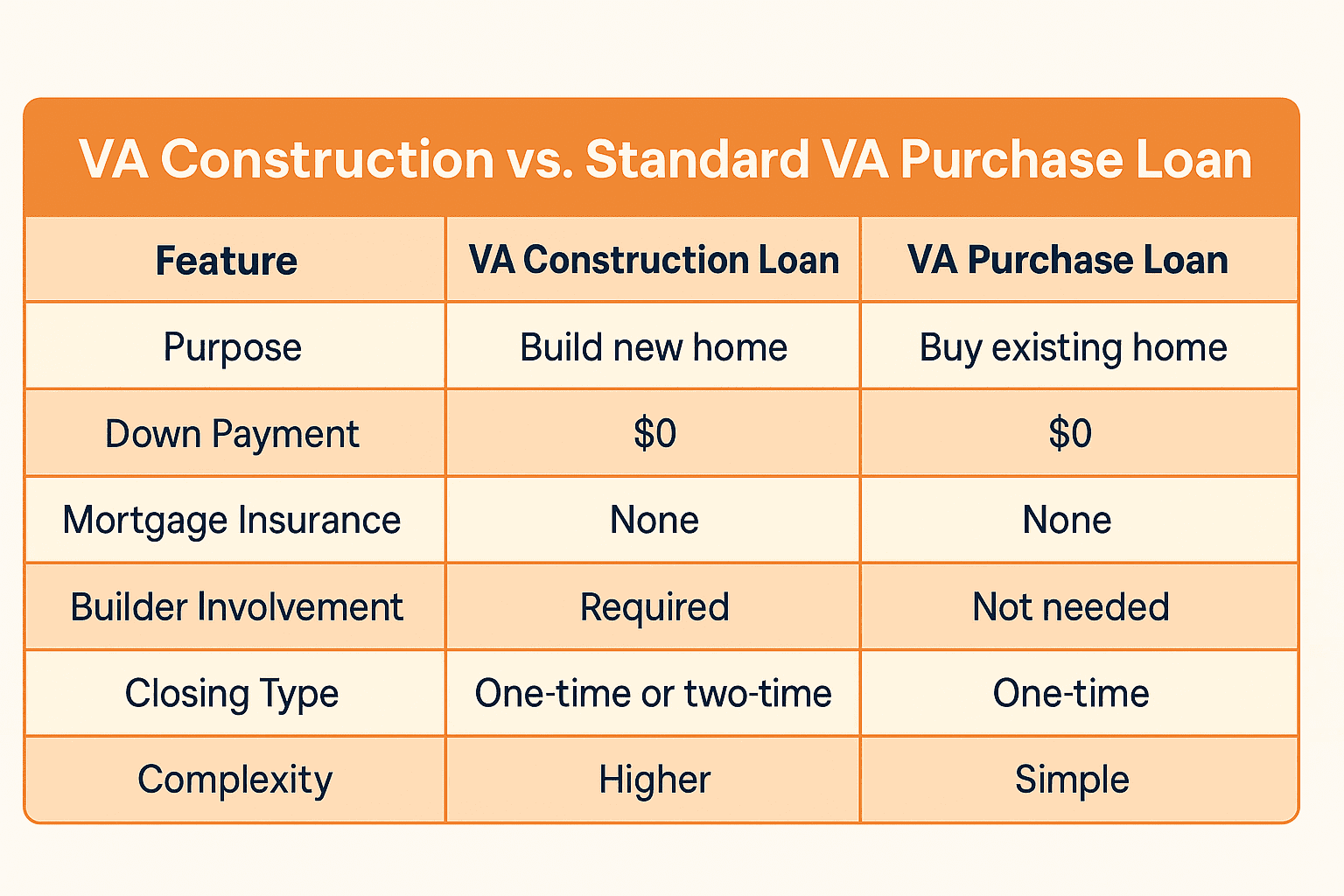
VA construction loans - Provide competitive terms for eligible veterans without any initial investment requirements
Local bank construction loans - May offer competitive terms in specific markets with flexible underwriting for unique situations
Owner-builder construction - Allows owners to act as general contractors but requires substantial construction knowledge and time investment
Each option presents distinct advantages and limitations. Your optimal choice depends on property location, income level, construction timeline, and personal preferences regarding builder relationships and project oversight.
What Documentation Do You Need for USDA Construction Loans?
What paperwork is required for USDA construction financing applications?
Comprehensive documentation requirements include:
Personal financial documents:
- Two years of federal tax returns with all schedules and supporting forms
- Recent pay stubs covering 30-60 days for employed applicants
- Bank statements from all accounts spanning 60 days
- Retirement account statements showing balances and distribution options
- Documentation of any other income sources including investments, alimony, or government benefits
Property and construction documents:
- Complete architectural plans with floor layouts and elevations
- Detailed construction specifications covering materials and methods
- Itemized cost breakdown from the builder showing all expenses
- Builder's license, insurance certificates, and financial references
- Property survey showing boundaries and easements
- Preliminary title report identifying any liens or encumbrances
- Soil tests and engineering reports if required by local conditions
Credit and identity verification:
- Valid government-issued identification
- Social Security cards for all applicants
- Proof of U.S. citizenship or permanent resident status
- Written explanations for any credit issues or irregularities
- Authorization for credit report inquiries
Organized, complete documentation accelerates the approval process and reduces delays from missing information or unclear circumstances.
Can You Finance Modular or Manufactured Home Construction?
Does USDA construction financing cover factory-built housing?
USDA construction loans can finance modular homes built to local building codes and permanently affixed to foundations. However, manufactured homes built solely to HUD code typically don't qualify for USDA construction financing—they require specialized manufactured home financing programs.
Key distinctions:
Modular homes (may qualify):
- Built to local building codes, not just HUD standards
- Constructed in sections and assembled on-site
- Permanently attached to foundations
- Titled as real property, not personal property
- Comparable to site-built construction in quality and permanence
Manufactured homes (generally don't qualify for construction loans):
- Built solely to HUD code standards
- Constructed entirely in factory settings
- Transported to sites as complete units
- May or may not be permanently affixed
- Often titled as personal property
If considering modular construction, verify with your lender that the specific building system and manufacturer meet USDA requirements before proceeding with design and planning.
What Are Common Reasons for USDA Construction Loan Denial?
Why do USDA construction loan applications get rejected?
Understanding common denial reasons helps applicants avoid preventable issues:
Geographic ineligibility - Properties located outside USDA-designated rural areas automatically disqualify
Income exceeding limits - Household income above 115% of area median income for location and family size
Insufficient credit history - Inadequate credit records or serious delinquencies without acceptable explanations
Unstable employment - Recent job changes, gaps in employment, or declining income trends
Excessive debt obligations - Monthly debts consuming too much income to comfortably afford housing expenses
Inadequate construction plans - Incomplete plans, unrealistic budgets, or designs exceeding USDA modest housing standards
Unqualified builders - Contractors lacking proper licensing, insurance, or financial stability
Property deficiencies - Land parcels with access issues, environmental problems, or zoning restrictions
Incomplete documentation - Missing financial records, unclear income verification, or insufficient construction details
Addressing these areas proactively before applying significantly increases approval probability and reduces processing delays.
How Does Financing Work During Construction?
What charges apply during the construction period?
During construction, you typically make interest-only payments based on funds disbursed to date. As construction progresses and additional draws release, interest payments increase proportionally. This structure minimizes carrying costs during construction when you're not yet occupying the property.
Interest calculation details:
- Daily accrual - Interest accrues daily on outstanding construction balances
- Monthly payments - You make interest-only payments on disbursed amounts
- Rate consistency - Your financing terms remain fixed from initial closing through permanent conversion
- Payment adjustments - Monthly payments increase with each construction draw
After construction completes and the loan converts to permanent financing, payments transition to standard principal and interest payments amortizing over the remaining term.
This structure provides predictable costs and avoids the double expense of both rent and construction loan payments during the building period.
Not sure which program is right for you? Take our discovery quiz to find your path.
Alternative Loan Programs for Rural and Construction Borrowers
If a USDA construction loan isn't the right fit, consider these alternatives:
- USDA Loan - Standard USDA financing for purchasing existing homes in rural areas without construction components
- VA Construction Loan - Construction-to-permanent financing for eligible military families with competitive VA benefits
- FHA Construction Loan - Government-backed construction financing with accessible qualification standards
- Construction Loan - Conventional construction financing for building outside USDA-eligible areas or when income exceeds limits
- FHA 203k Loan - Purchase existing homes and finance renovations rather than building from scratch
Explore all 30+ loan programs to find your best option.
Ready to get started? Apply now or schedule a call to discuss your situation.
Helpful USDA Construction Loan Resources
Official Government Guidance
USDA Rural Development Single Family Housing Programs - Comprehensive overview of USDA guaranteed loan programs, eligibility requirements, and program features for rural housing development.
USDA Property Eligibility Map Tool - Interactive mapping system allowing users to verify whether specific addresses qualify for USDA financing based on current geographic designations.
USDA Income Eligibility Standards by County - Official documentation of income limits for USDA guaranteed loan programs organized by state, county, and household size.
Construction and Building Standards
HUD Construction Requirements and Standards - Federal housing construction standards covering minimum property requirements, inspection protocols, and quality benchmarks applicable to government-backed financing.
International Code Council Building Codes - Professional organization publishing model building codes adopted by most U.S. jurisdictions, providing standards for residential construction safety and quality.
Educational Resources
Consumer Financial Protection Bureau Mortgage Resources - Federal consumer protection agency providing unbiased information about mortgage financing, closing processes, and borrower rights.
HUD Housing Counseling Services Locator - Directory of HUD-approved housing counselors offering free or low-cost assistance with mortgage questions, financial planning, and homeownership education.
Professional Organizations
National Association of Home Builders - Trade association representing residential construction industry professionals, offering consumer resources about building processes, contractor selection, and construction best practices.
Need a Pre-Approval Letter—Fast?
Buying a home soon? Complete our short form and we’ll connect you with the best loan options for your target property and financial situation—fast.
- Only 2 minutes to complete
- Quick turnaround on pre-approval
- No credit score impact
Got a Few Questions First?
Let’s talk it through. Book a call and one of our friendly advisors will be in touch to guide you personally. Schedule A CallNot Sure About Your Next Step?
Skip the guesswork. Take our quick Discovery Quiz to uncover your top financial priorities, so we can guide you toward the wealth-building strategies that fit your life.
- Takes just 5 minutes
- Tailored results based on your answers
- No credit check required